Assegai MaxxGrip up front and Minion DHR II MaxxTerra out back, DoubleDown casing for enduro and e-bikes, EXO+ for trail. That combination covers the majority of situations in the mountains, on roots and rocks. Everything else comes down to conditions, weight and how much grip you're willing to trade for rolling speed. Below I break down the entire Maxxis system into its parts: tread, compound, casing, width and pressure, because only from those five variables does a sensible tyre choice emerge.
Three variables on the sidewall: tread, compound, casing
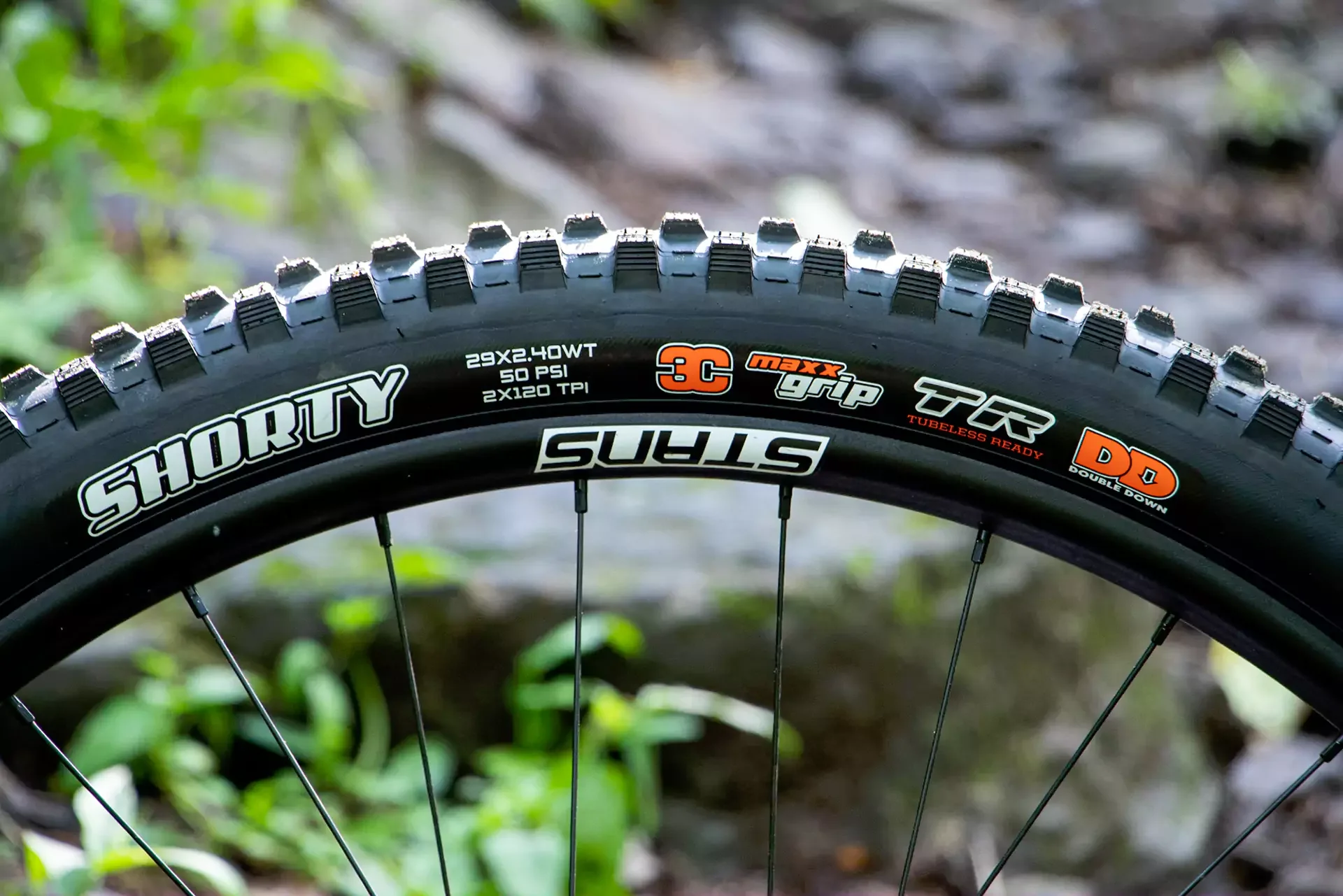
A typical sidewall marking looks like this: Maxxis Assegai 29x2.50 3C MaxxGrip EXO+ TR. Assegai is the tread model, 3C MaxxGrip is the rubber compound, EXO+ is the casing (carcass protection), and TR stands for Tubeless Ready. The biggest mistake when buying is looking only at the model name, because an Assegai EXO MaxxTerra and an Assegai DH MaxxGrip are two completely different tyres in terms of weight, grip, damping and puncture resistance.
The selection logic is straightforward: you choose the tread for the terrain, the compound for the grip-to-durability ratio, and the casing for your riding style and system weight (rider plus bike). Only the combination of those three gives you a tyre that suits a specific application.
MaxxGrip, MaxxTerra, Dual
Maxxis uses three main compounds in its trail, enduro and DH tyres: Dual is the cheapest and fastest-rolling option with moderate grip and good durability, a sensible choice for a dry rear or bike park on hard-packed ground. 3C MaxxTerra is a middle-ground compound with noticeably better grip than Dual but slower wear than MaxxGrip, making it the best compromise for a rear tyre. 3C MaxxGrip is Maxxis's stickiest and slowest-rebounding MTB compound, used when grip is the priority: front in enduro, wet trails, DH racing.
Compound | Grip | Rolling | Durability | Typical use |
|---|---|---|---|---|
Dual | moderate | fast | good | dry rear, budget, bike park on hard-pack |
3C MaxxTerra | high | moderate | moderate/good | best compromise for the rear |
3C MaxxGrip | very high | slow | faster wear | enduro/DH front, wet conditions, racing |
The rule I've used for years: MaxxGrip up front, MaxxTerra out back. MaxxGrip on both wheels makes sense for DH, bike park and wet race tracks, but for everyday riding it will feel heavy and slow, and the rear tyre will disappear faster than you'd like.
EXO, EXO+, DoubleDown, DH: casing for your weight and style
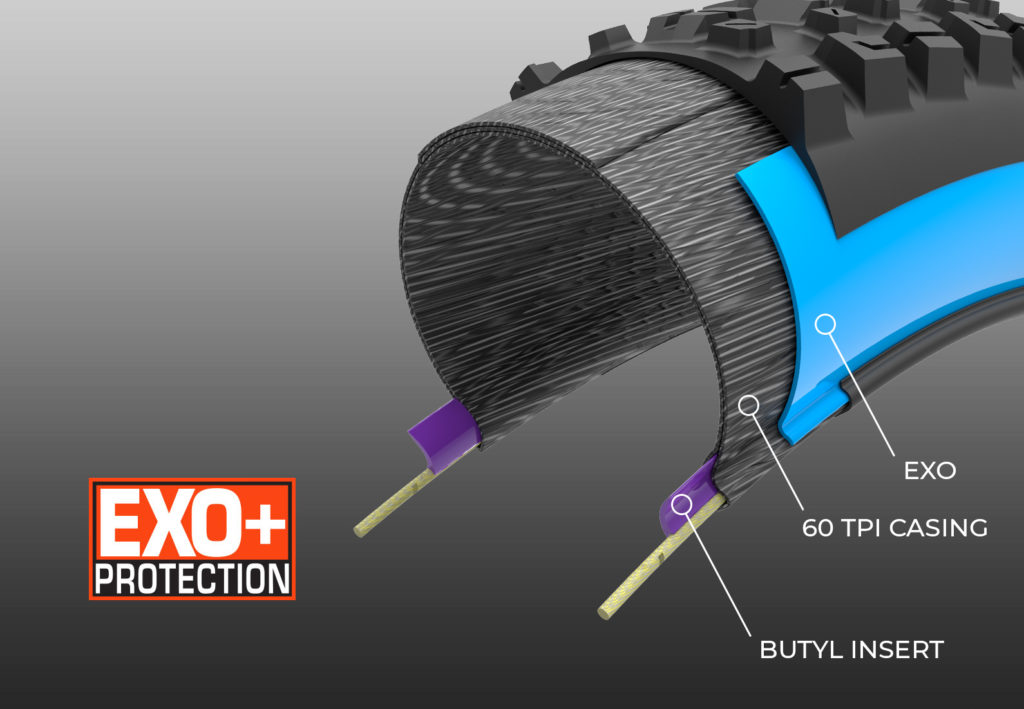
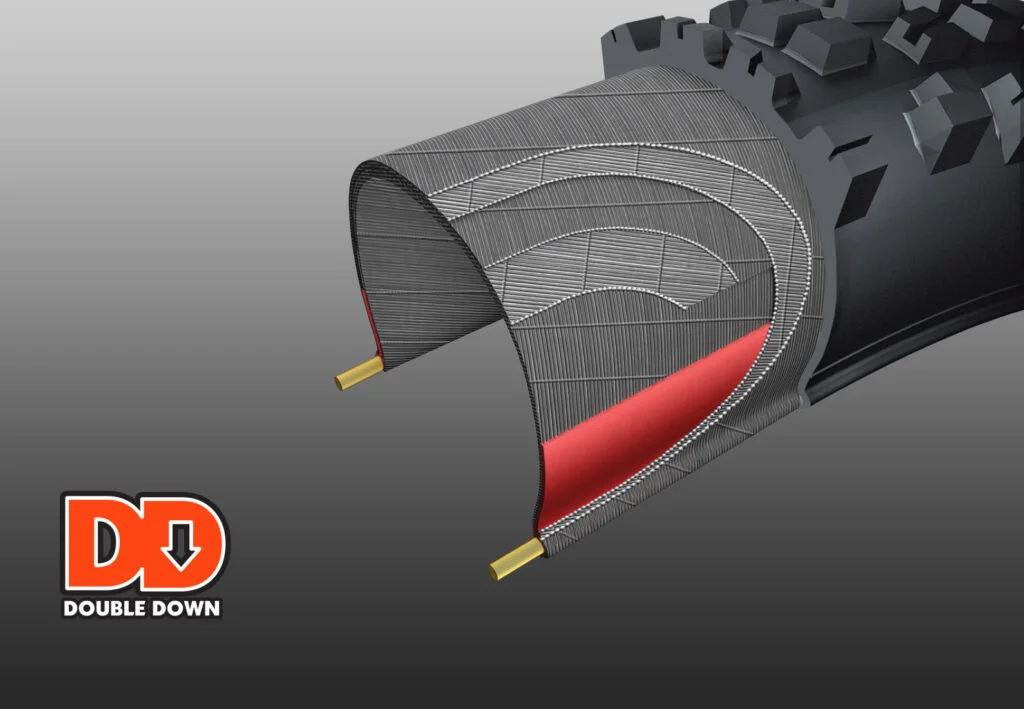
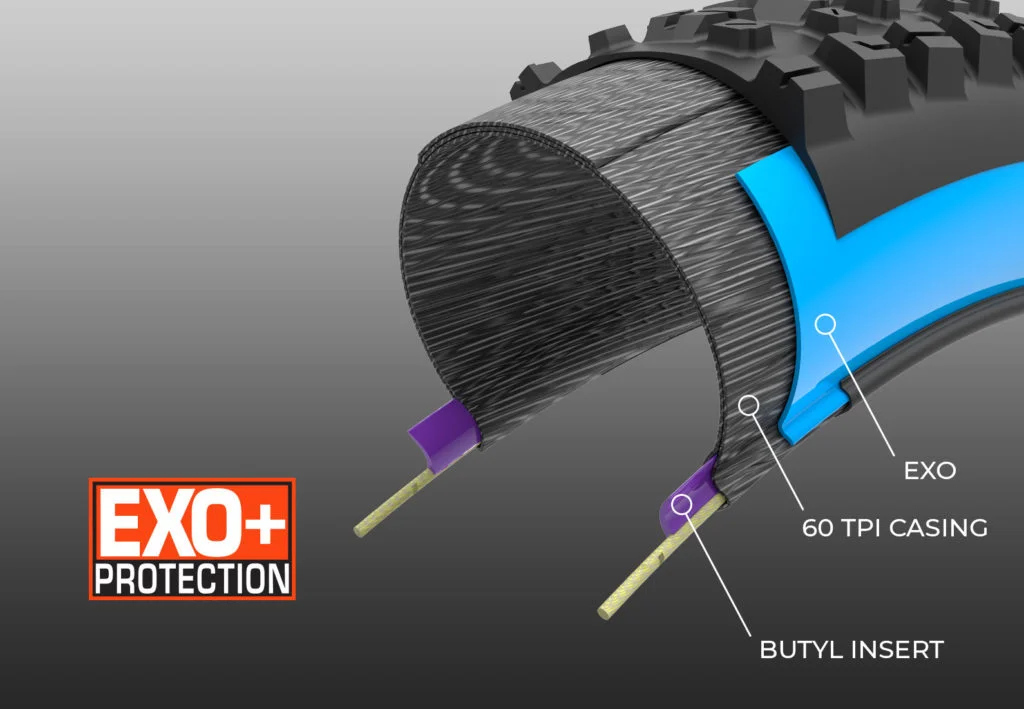
The casing is more than just puncture protection. A stiffer carcass gives cornering stability, rim-strike resistance, better damping and more precise handling. Maxxis offers four levels: EXO is lightweight sidewall protection for XC and mellow trail. EXO+ is mid-level protection for trail and light e-bikes. DoubleDown (DD) has two layers of 120 TPI with a butyl insert, designed for enduro and e-bikes. DH is the strongest, heaviest casing for downhill and bike park.
Casing | Character | Use |
|---|---|---|
EXO | light, fast, delicate | light trail, XC |
EXO+ | sensible compromise | trail, all-mountain, light e-bike |
DoubleDown | high support and resistance | enduro, e-bike, sharp rocks |
DH | maximum stability and damping | DH, bike park, freeride, heavy e-bike |
The rear takes significantly more punishment than the front: rim strikes, rocks, braking, landings, the full weight of the rider and bike. That's why a sensible setup is often EXO+ up front and DD out back, rather than EXO+ on both wheels, if you ride harder than mellow singletrack spinning.
Riding style | Front | Rear |
|---|---|---|
Trail | EXO+ | EXO+ |
Aggressive trail | EXO+ | EXO+ / DD |
Enduro | EXO+ / DD | DD |
E-bike enduro | DD | DD / DH |
Bike park | DD / DH | DH |
DH | DH | DH |
Casing selection by rider weight: up to 75 kg on trail, EXO+ is sufficient. At 80–100 kg in enduro, DD on the rear is better. Above 85 kg on an e-bike, DD on the rear is the minimum; DH makes sense on sharp rocks and in bike park.
Nine Maxxis models: tread for every terrain
Assegai is the best front option when maximum confidence is the priority. The aggressive tread delivers predictable grip across the full profile: roots, rocks, steep chutes, wet berms. It rolls slower than the DHF, but it rarely surprises you. The best front version for enduro is MaxxGrip in a DD casing; EXO+ MaxxGrip is enough for trail.
Minion DHF is the classic front tyre, faster and lighter in character than the Assegai. It balances rolling speed, braking and cornering. For faster trail and dry conditions the DHF will be the better choice, but in wet forests and steep technical terrain the Assegai gives more margin for error.
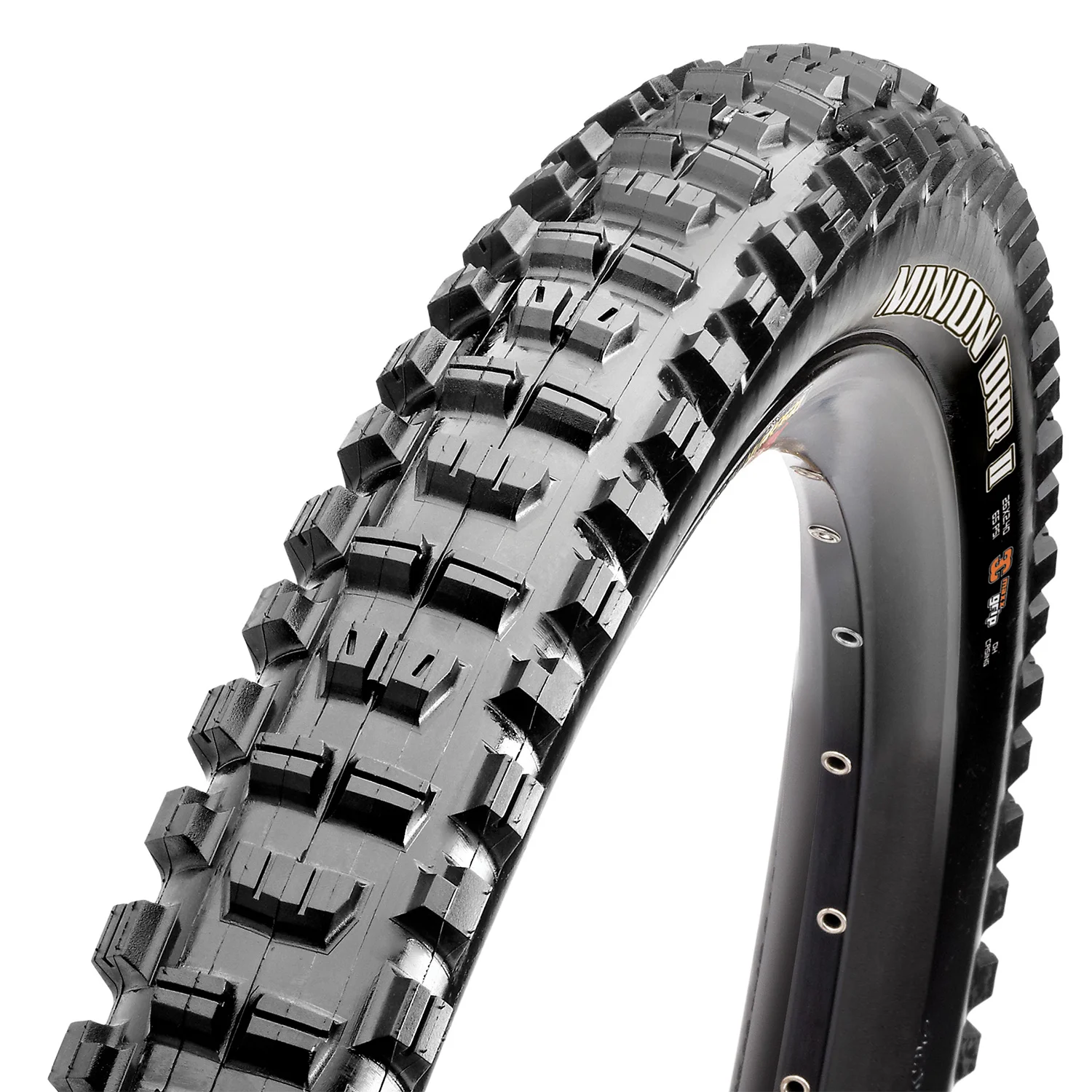
Minion DHR II is Maxxis's best enduro rear tyre, with strong braking knobs and DHF-inspired side knobs. The classic DHF front plus DHR II rear pairing is Maxxis's own recommendation. The tyre comes in all casings and compounds from Dual to MaxxGrip, so it can be configured for every scenario except deep mud.
Dissector in its 2025 version received updated side knobs; it rolls noticeably better than the DHR II, but brakes less effectively on steep terrain and holds less on wet roots. On a 130–140 mm trail bike it can also work as a front tyre.
High Roller is positioned between the Assegai and the Shorty: a more open tread with well-supported side knobs. It works well in loose dirt, dust, blown-out berms and chewed-up bike park trails where a classic DHF or Assegai doesn't self-clean as well.
Shorty (redesigned in 2021) is the wet, soft and loose tyre. The revised knob layout improved traction in the wet and mud-shedding ability. Available in 2.40 width, in MaxxTerra and MaxxGrip compounds and EXO, DD and DH casings. A solid choice for autumn mountains, wet roots and soft ground, but on dry hard-pack it will roll like a log.
Wetscream is a specialist DH tyre for deep mud, intended for race use. For regular enduro riding in the mountains you'll more often reach for the Shorty, leaving the Wetscream for genuinely boggy conditions where nothing else clears.
Aggressor is a fast, durable rear tyre for dry and rocky trails, available in the Dual compound and EXO and DD casings. Maxxis suggests it as a rear tyre paired with a DHF or Assegai up front. On wet roots it will lose traction noticeably sooner than the DHR II.
Minion SS is a semi-slick rear tyre with significantly lowered centre knobs. Very fast rolling, but poor braking and weak traction in the wet. A tyre for dry flow trails, paired with a Dissector, DHF or Assegai up front.
Front/rear pairings: eight scenarios in one table
Application | Front | Rear |
|---|---|---|
Fast trail | DHF EXO+ MaxxTerra | Dissector EXO+ MaxxTerra |
Trail with grip | Assegai EXO+ MaxxGrip | Dissector EXO+ MaxxTerra |
All-round enduro | Assegai DD MaxxGrip | DHR II DD MaxxTerra |
E-bike enduro | Assegai DD MaxxGrip | DHR II DD/DH MaxxTerra |
Bike park | Assegai DH MaxxGrip | DHR II DH MaxxGrip |
Loose, dusty, blown-out trails | High Roller DD MaxxGrip | DHR II DD MaxxTerra |
Wet, roots, autumn | Shorty DD MaxxGrip | DHR II DD MaxxTerra |
Dry flow | DHF EXO+ MaxxTerra | Aggressor EXO / Minion SS |
Width 2.4 vs 2.5 vs 2.6: what to choose
The standard choice for trail and enduro is 2.5 up front and 2.4 out back. In 2025 Maxxis began phasing out the WT (Wide Trail) designation for the 2.40 and 2.50 sizes, as those tyres are now designed around 30–35 mm rims as standard. This is a labelling change, not a construction change. A 2.6 width gives a larger air volume and more comfort, but in aggressive enduro a stiff DD casing in a 2.4 is often the better choice than a soft EXO in a 2.6, because a stronger casing provides the support that width alone cannot replace.
Starting pressures for tubeless 2.4–2.5
Rider weight with gear | Front | Rear |
|---|---|---|
60–70 kg | 1.25–1,40 bar | 1.45–1,65 bar |
70–80 kg | 1.35–1,50 bar | 1.55–1,80 bar |
80–90 kg | 1.45–1,65 bar | 1.75–2,00 bar |
90–105 kg | 1.60–1,85 bar | 1.95–2,20 bar |
These values are a starting point. If the tyre washes out in corners, add 0,1 bar or consider a stiffer casing. If you're rimming out, add 0.1–0,2 bar or move to DD/DH. On an e-bike you typically need to add around 0,1 bar at the rear due to the higher system weight. The RideLab tyre pressure calculator will give you more precise values using the tire-drop method based on system weight, tyre width and terrain.
E-bike: why EXO on the rear isn't enough
An e-bike puts more load on the rear tyre than an unpowered bike. Higher system weight (bike plus battery plus rider is often 110–120 kg), greater torque on climbs, harder rim strikes and higher speeds on flat sections all translate into faster carcass wear and a higher risk of sidewall cuts. On a light e-bike trail EXO+ on the rear may still be adequate, but for e-bike enduro DoubleDown on the rear is the minimum. If you frequently ride on rocks, in bike parks, or regularly rim out, DH on the rear is a more sensible investment than repeatedly patching tyres.
Five mistakes I see in the workshop
EXO on the rear for heavy enduro and e-bike use is the most common problem: the carcass is too fragile for harder riding and a sliced sidewall ends a ride faster than you'd expect. MaxxGrip on the rear for everyday riding with lots of climbing generates real rolling resistance and wears noticeably faster than MaxxTerra, so it only makes sense for racing and bike park. Minion SS on wet enduro is asking for trouble, this tyre is designed for dry flow trails and slides without warning on wet roots. Assuming 2.6 is always better than 2.4 ignores the fact that a stiff DD casing in a narrower tyre gives better support than a soft EXO in a wider one. Pumping the rear up to absurdly high pressure instead of changing the casing is treating the symptom rather than the cause: if you need to run 2,5 bar to avoid rimming out, you need DD or DH.
The most sensible Maxxis setup for harder riding: Assegai MaxxGrip up front, DHR II MaxxTerra out back, EXO+ or DD casing for trail/enduro, DD or DH for e-bike and bike park.
If you want the bike to be faster, swap the rear for a Dissector. If it gets wet and soft, swap the front for a Shorty. If you're heading to the bike park, take the DH casing and accept the extra 200 g, because a sliced tyre costs more than that weight difference.
Sources
- 01